A casino offers you 30 to play with, no deposit required. This is not generosity. This is behavioral architecture.
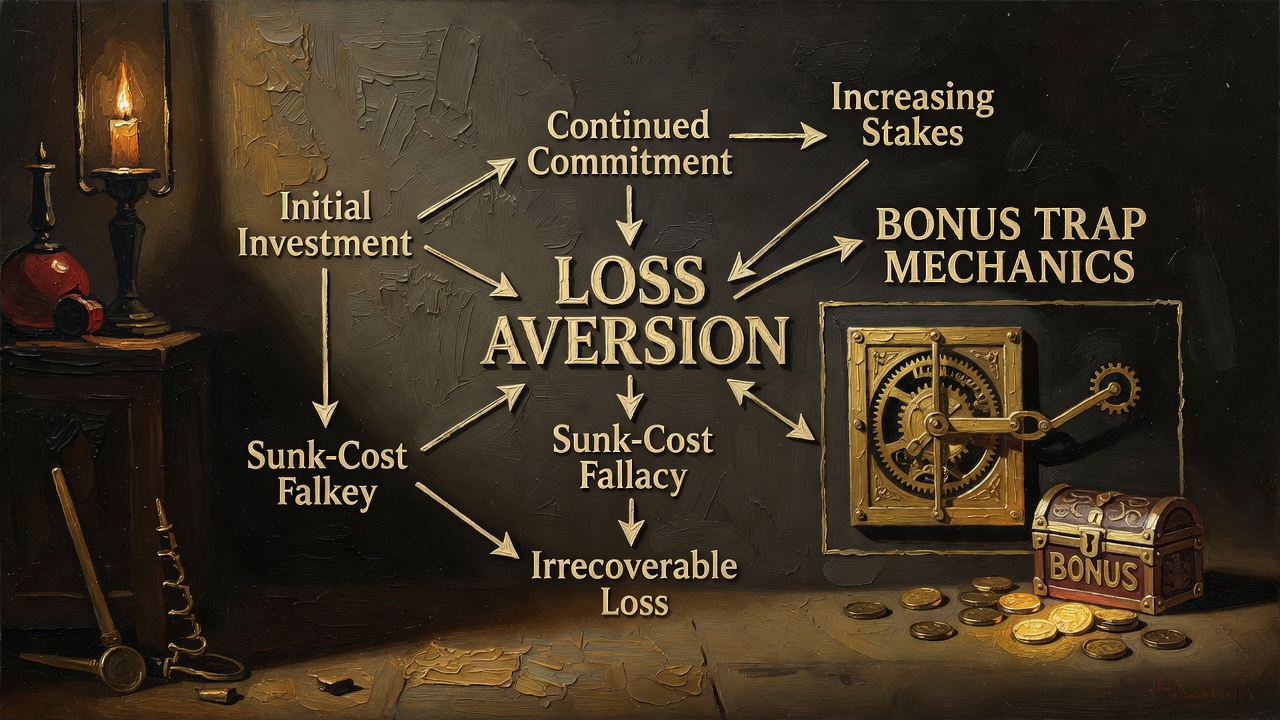
Daniel Kahneman's work on prospect theory gives us the underlying mechanism. Humans experience losses roughly twice as painfully as equivalent gains. A 30 bonus on a 30 account is a gain that feels substantial. But behavioral economists know that the pain of losing that bonus (or the original account balance that came with it) will be approximately twice as sharp. What the casino is doing is creating an asymmetry: they're using your loss aversion to keep you in action.
How Loss Aversion Gets Engineered
You receive 30 in casino credit, no deposit. You have a playthrough requirement of 50x. This means 1,500 in total wagered before you can withdraw anything. At a roulette table with a 2.7% house edge, your expected loss over 1,500 is approximately 40. You're playing with 30 in house money plus your own accumulated losses. The structure is designed so that after about thirty minutes of play, you'll dip below your starting balance.
The question Kahneman would ask: do you stop, take the loss of 5 or 10, and walk away with the rest? Or do you add your own money to recoup the loss and hit the playthrough requirement?
Research suggests most people choose the second option. This is called the break-even effect. We're motivated to eliminate losses more strongly than we're motivated to earn equivalent gains. A casino that wants to retain players post-signup uses this: the no-deposit bonus creates an initial loss (through normal variance and house edge), and loss aversion then motivates the player to deposit their own money to chase it.
The Playthrough Mechanism
The playthrough requirement itself is a sunk-cost fallacy machine. You've wagered 800 of your required 1,500. You've lost 15. The bonus has been mostly clawed back. You're now faced with a choice: stop (accept a 15 loss) or continue to complete the playthrough (face expected additional losses of 19 to finish the remaining 700 wagered).
Most players continue. The money is already spent. The reasoning is automatic and unconscious: "I'm almost there, I might as well finish." This is the definition of sunk-cost fallacy. The 800 already wagered is gone. The decision to continue should be based only on the expected value of the remaining 700 wagered. But instead, it's based on the fact that you've already invested so much.
For table games specifically, the playthrough requirement becomes a form of endurance test. Blackjack with basic strategy has a house edge around 0.5% to 1%. A 50x playthrough on a 30 bonus requires 1,500 wagered to complete. If you're betting 25 per hand (most online table minimums are 25 to 50), you're looking at sixty hands. That's two to three hours of play. The variance over that period could be substantial. A lucky streak could leave you ahead. An unlucky streak could dig you into a hole that only fresh deposits can fill.
The Mental Accounting Problem
Richard Thaler's concept of mental accounting suggests that we compartmentalize money. The bonus feels like house money, which we treat differently than our own money. We take bigger risks with house money. We're more willing to make bad bets.
A casino knows this. The no-deposit bonus is deliberately small (30 to 50 typically) and requires substantial playthrough (40x to 50x). The goal is to: create the mental category of "house money" (which you'll risk freely), deplete it quickly through normal variance, then use loss aversion to motivate a deposit of real money (which you'll be more careful with, but by then you're already in action).
The Regulatory Framing
For table games, regulators in the UKGC and equivalent bodies have begun requiring clearer disclosure of expected value. The fine print must now say something like: "This bonus contributes 50% to playthrough requirements on table games." What this means: a 30 bonus only counts as 15 toward your 1,500 requirement if you're playing blackjack. Slots count 100%. Roulette counts somewhere in between.
This two-tier system exists because table games have lower house edges. A 30 bonus clearing a 50x playthrough requirement in roulette (edge 2.7%) would cost the casino roughly 40 in expected loss. That's expensive for the casino. But if only 50% of your bonus counts toward playthrough, you need to wager 3,000 instead of 1,500. Suddenly the casino's cost is sustainable.
From a behavioral standpoint, this makes the bonus even less attractive than it appears. You're no longer completing a playthrough in two hours. You're now looking at four to six hours. The longer action, the more time for variance to compound in the house's favor.
The Actual Expected Value
Let's run the math: 30 bonus, 50x playthrough on blackjack (50% contribution = 100x effective, 3,000 required wagered), house edge 0.5%. Expected loss: 15. You keep, on average, 15 from the bonus after playthrough.
A no-deposit offer that nets you an expected 15 in winnings while requiring three hours of action is economically rational only if you value your time at 5 per hour or less. Most people don't. Most people are getting paid in psychological engagement (the feeling of playing) rather than economic return.
The casino knows this. The bonus exists not to be profitable for you, but to remove the friction of signup and to exploit the behavioral biases that keep you in action longer than cold economic calculation would suggest.