Why Casino Bonuses Expire: The Economics of Hope
Casino bonuses expire not because the money is expensive, but because deadlines make spending feel urgent and necessary rather than optional.
Jump to a section (4)
A bonus that lasts forever isn't a bonus anymore; it's part of the platform. The moment a casino sets an expiration date on a promotional credit, they're not just managing inventory; they're managing the most delicate commodity in gambling: urgency. The time limit transforms a product into an opportunity, and opportunities have the peculiar ability to feel valuable precisely because they will soon cease to exist. This is economics, but it's also human nature, and understanding why bonuses expire requires understanding why we decide to play in the first place.
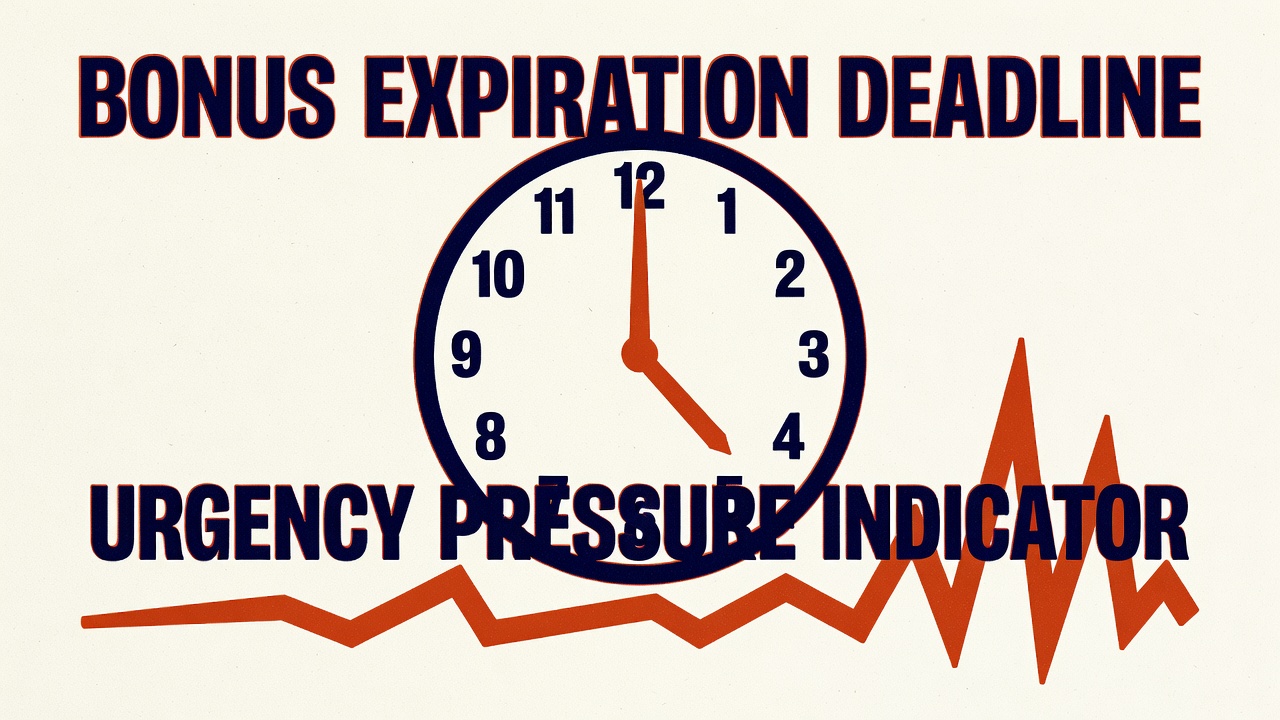
Take the standard welcome offer: five hundred dollars to play with, valid for thirty days. The casino knows that a significant percentage of players will never touch that bonus unless the deadline creates pressure. Sixty days seems safer, more reasonable, less likely to trigger panic. Thirty days does something the sixty-day window cannot: it makes the decision urgent. A player who might have spent thirty dollars next month instead spends two hundred dollars this week because the window is closing. The expiration date is not a limitation of the system; it's the point of the system. The casino manufactures scarcity, and scarcity drives behavior.
The Daydream Window Has an Optimal Length
Lottery players like myself understand something that purely rational actors cannot: there's an economically defensible reason to buy a two-dollar ticket for the pure imaginative value it provides. That ticket doesn't make mathematical sense, but it offers exactly seventy-two hours of productive daydreaming about what the money might change, and at two dollars per seventy-two hours, that's a defensible entertainment expenditure. Bonuses work similarly, except casinos have engineered them to be far more efficient at capturing that impulse. The thirty-day window is precisely long enough to feel like you have options, but short enough that you cannot actually think strategically. You must act, or lose the opportunity.
Casinos have spent decades analyzing which expiration windows convert the most players to active spending. Seven days is too aggressive; it triggers skepticism and resentment. Ninety days is too generous; the urgency evaporates. Thirty days hits the psychological sweet spot where a player feels both possibility and pressure. The bonus doesn't actually need to exist at that length of time; the time limit creates the bonus's primary value, which is psychological, not financial.
The Smaller Bonuses Expire Even Faster
Notice that ongoing seasonal bonuses expire in days, not weeks. A free-spin coupon valid for only forty-eight hours manufactures a different kind of urgency: this is not a mathematical decision but an impulse decision. Forty-eight hours is too short to do research, to weigh options, to consider whether you're making a sound decision. It's long enough to feel achievable but too short to feel like you have control. This is where the real mechanism lives. The expiration creates the urgency that drives the action, and the action is the entire point.
Bonuses don't expire because the money is expensive; they expire because they're more effective when your prefrontal cortex is not involved in the decision.
The economic justification is sensible: if casinos didn't set expiration windows, they'd be giving away genuine money with no behavioral advantage. But the deeper truth is that expiration dates serve a dual purpose. They limit liability while maximizing the emotional stakes of the offer. A player who has forty-eight hours to use a one-hundred-dollar bonus feels different than a player who has six months. One is an opportunity; one is a utility. Casinos sell opportunities, not utilities.
The philosopher's version of this is simple: bonuses expire because indefinite generosity is indistinguishable from a lack of scarcity, and scarcity is what makes the offer feel real. The expiration is the offer. Without it, there is no moment where you must choose, and without that moment of choice, there's no satisfaction in the decision, no feeling that you've outsmarted the system. The casino manufactures the moment, you inhabit it, and the expiration date ensures that moment never lasts long enough for regret to properly set in.