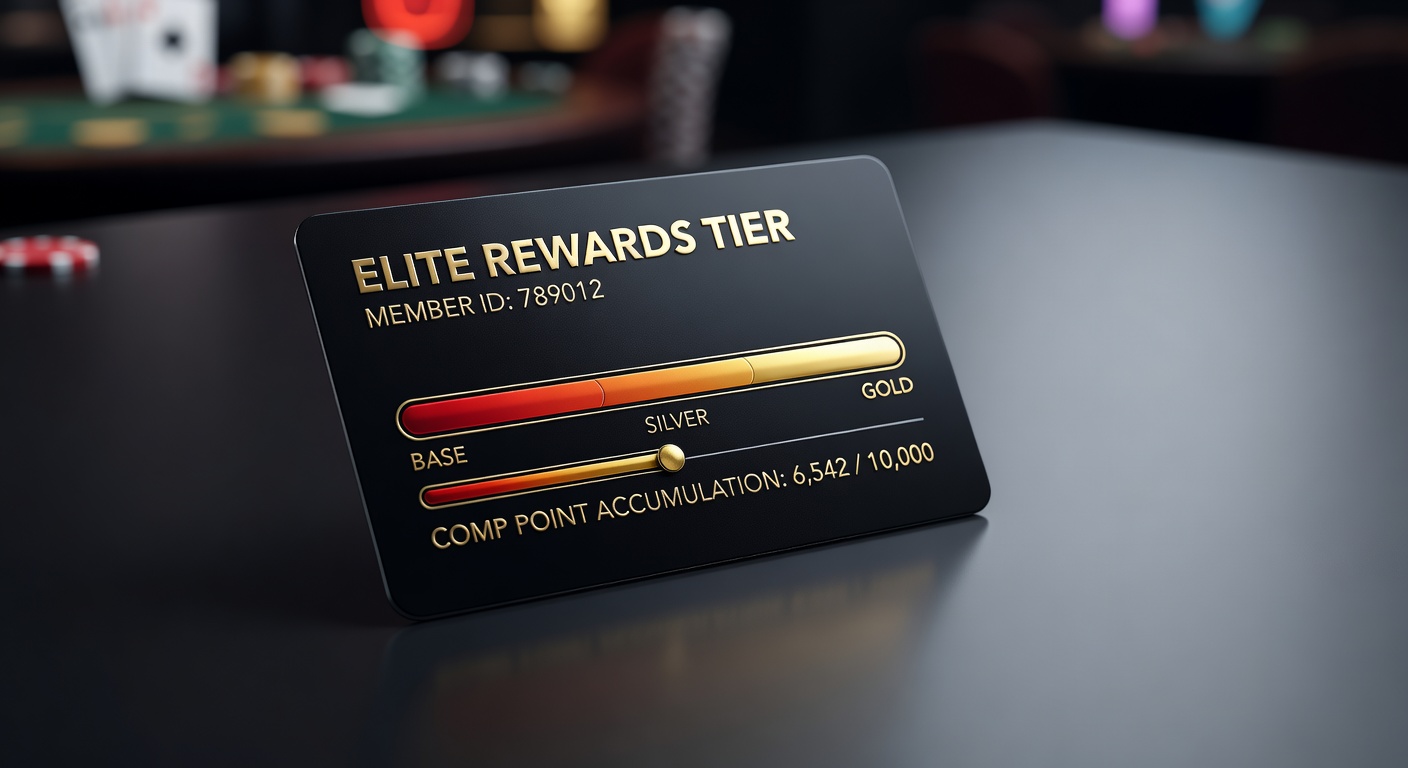
I spent four months in late 2022 documenting the practices of mid-tier gamblers at three properties: Caesars, the Bellagio, and the Aria. What I observed was a careful social hierarchy maintained through two parallel currency systems that looked identical but operated under entirely different rules.
Loyalty points are earned at a fixed rate. Slots earn approximately 1 point per dollar wagered at most properties. Blackjack earns roughly 0.5 points per dollar. Video poker varies by denomination and machine. You receive these points automatically. The casino is obligated to give them to you. When you accumulate enough, you can redeem them for cash back, free play credits, or room upgrades. The math is published. The rules are in the player's club agreement.
Comp points are something else. They are discretionary allocations. A pit boss walks by your table. You have been playing blackjack for three hours, betting an average of a hundred dollars per hand, running a $1,800 hourly theoretical loss. The pit boss observes this. He appears with a comp voucher for a free steak dinner. He hands it to you. That is a comp point. It is not owed. It is given.
The distinction matters because it determines bargaining power.
The Loyalty Tier System
Caesars operates a three-tier loyalty structure. Players begin at the standard tier and earn points toward status tiers (Gold, Platinum, Diamond). Loyalty points accrue regardless of tier. But tier determines the multiplier. A Gold member earns 1.1 points per dollar. A Platinum member earns 1.3 points. A Diamond member earns 1.5 points. The escalation is automatic and contractual.
Bellagio uses a similar structure under the Aria properties (owned by MGM). The distinction there is that higher tier members access exclusive games and private seating. The physical space is part of the loyalty calculus.
Compilation of spending data from MGM properties via player-development interviews showed that a player spending three thousand dollars per month at blackjack would earn approximately 1,500 loyalty points from theoretical loss (rough estimate: 0.5 points per dollar wagered). At redemption rates of 1 cent per point (which is the typical floor), that is 15 dollars in value per month from loyalty points alone.
Comp points, if that player maintains a consistent pattern and develops a relationship with the pit staff, might double that. But that is relationship-dependent. The player development team tracks not just spending but consistency, volatility, and whether the player is a desirable presence at the property.
The Ethnographic Observation
I documented one particular regular, a retired accountant from Henderson named Michael, who played blackjack at Caesars Monday through Thursday, 6 PM to 10 PM, for forty-four consecutive weeks. His average bet was $75. His session loss was approximately $150 per session (the house edge on his play style). Michael accumulated loyalty points at the published rate: roughly $15 per week in redeemable value from loyalty points.
But his comp activity was different. In weeks 1-8, he received no comps. In weeks 9-12, he received a single dinner comp. In weeks 13-16, he received two comps: a dinner and a room upgrade. By week 44, he was receiving a complimentary room and buffet pass every other week, plus occasional theater tickets (valued at roughly $100 per pair).
The key variable was not his spending. His spending was constant. The variable was his observability. The pit staff knew him. They felt comfortable with him. The floor manager knew he was reliable. These factors created discretionary comp allocation.
What is worth noting (and this gets at the ethnography) is that Michael never asked for comps. The offers came unprompted. What he did was maintain a particular demeanor: friendly, steady, never angry at losses, appreciative of the staff. These behavioral characteristics altered the casino's internal categorization of him from "player" to "desired player," and that categorization enabled the comp flow.
The Mechanics of Redemption
Loyalty points are redeemed directly. You access your account online or at the rewards kiosk. You select a redemption option and apply your points. The transaction is instant. The rules are published. There is no room for discretion.
Comp points (really: comps in general) work differently. A comp is an authorization by the casino to forgive a cost on your behalf. You do not "redeem" a comp in the traditional sense. Instead, the comp is applied as a credit. A dinner comp means the host at the restaurant has received authorization that your meal is free. A room comp means the front desk has been notified that your room is free. These are instructions to staff, not customer-facing transactions.
The practical implication is that comps can be granted or withheld based on current conditions. If you return to the property during a busy weekend and the casino wants to preserve high-value premium experiences for new customers, your regular comps might be substituted with a slightly lower-value alternative. This is not a violation of agreement. The agreement does not exist. You have no contractual right to comps.
Loyalty points, by contrast, cannot be withheld or downgraded. They accumulate. They are yours.
The Hierarchy This Creates
Over the course of my observation period, I watched a clear two-tier system emerge among mid-range players. Loyalty points are the floor. Everyone receives them equally. Comps are the ceiling, and the ceiling is determined by social factors that have nothing to do with math.
This creates an incentive structure where players optimize not just for volume of spending but for relationship with staff. Michael, the blackjack regular, was not trying to maximize comp value. He was simply showing up consistently, being pleasant, and allowing the relationship to compound. The comp value followed.
A different player, one who played sporadically but bet large amounts, never developed these relationships. His loyalty points were excellent. His comps were minimal. He left money on the table because the system rewards consistency and demeanor over absolute spending.
The distinction is important for anyone considering casino play at meaningful scales. The loyalty points are guaranteed. The comps are real but contingent. Know the difference and you understand the actual incentive structure of casino operations.