How Side Bets Quietly Raise the House Edge on Every Table Game
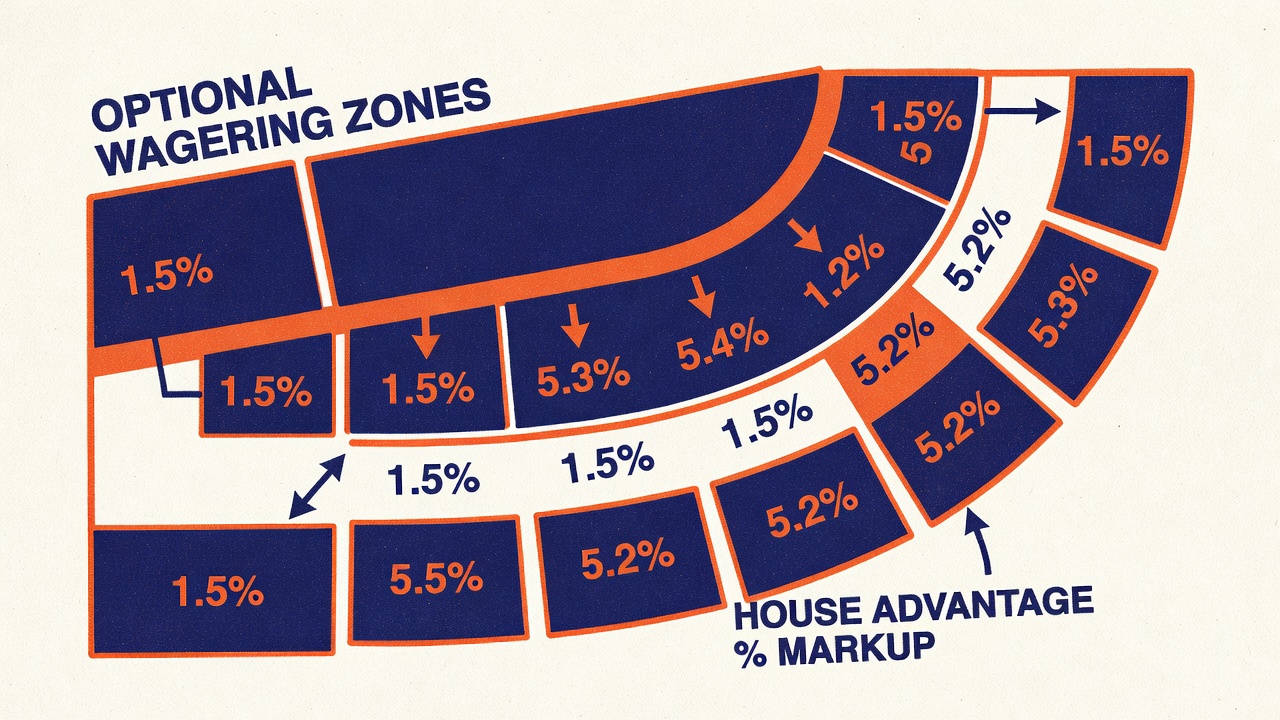
A side bet is an optional wager distinct from the main game. In blackjack, you can bet that your first two cards will be the same suit (Perfect Pair). In baccarat, you can bet on a tie. In Three Card Poker, you can bet on a Straight Flush. Each of these pays well (often 10:1 or better) and carries a house edge of 4 percent to 15 percent.
The main game (blackjack basic strategy, banker bets in baccarat, ante only in Three Card Poker) carries a 0.5 to 1.5 percent house edge. The side bet is 5-10 times worse. Yet these bets generate 20-30 percent of a casino's table game profit. This is not accident.
How They're Positioned
Side bets are printed directly on the table felt. Your hand is in the center. The side bet is right there, next to it. The dealer points to it. "Progressive Jackpot, double your money, three-card straight." The psychology is subtle but precise. The bet is already drawn. You just have to put chips on it.
In live dealer games, the side bets are flashing on your screen. "Side Bet Available." They're dynamic and highlighted. The main game is static. Which one draws your eye?
The Expected Value Breakdown
Take Perfect Pair blackjack. You're dealt two cards. The bet pays 5:1 if they're the same suit, 10:1 if they're the same rank and suit.
Probability of two cards being a Perfect Pair (same rank, same suit): 64 in 2,652 card combinations. That's 2.41 percent. The bet pays 25:1 if you win (standard payout). Expected value: (0.0241 times 25) minus (0.9759 times 1) equals roughly minus 5.5 percent. For every 100 dollars wagered on Perfect Pair, you expect to lose 5.50 dollars.
Compare: basic strategy blackjack with a 0.5 percent edge. For every 100 dollars wagered on the main game, you expect to lose 50 cents. The side bet is 11 times worse.
Why Players Take Them
Near-miss effects. You're dealt an Ace and King (blackjack). Not a Perfect Pair. But you were close. If your next hand is a pair, you're emotionally primed to bet on Perfect Pair. This is not rational. It is a well-documented bias.
Frequency bias. The main game pays 1:1 or 3:2. The side bet pays 10:1 or 25:1. The larger payout feels more likely than it is. A 25:1 payout sounds like "this happens sometimes." In reality, it happens once every 40 hands of Perfect Pair, statistically. But players remember the one time and forget the 39 times they lost.
The Operator's Perspective
A casino floor generates revenue from house edge times total wagered. If table games carry an average 1 percent edge, the casino needs higher table limits or longer session duration to hit revenue targets. Side bets are the answer. They offer 5-15 percent edges without changing the main game.
A table generating 100,000 USD in monthly main-game action might generate an additional 30,000 USD in side-bet action if the bets are well-positioned. That extra 30,000 USD, at a 10 percent edge, generates 3,000 USD in profit instead of 300 USD if it were on the main game.
Operators track side-bet attachment rates (what percentage of hands include a side bet) and optimize placement constantly. They move the bet location, change the payout, introduce a new variant. Whatever increases handle (total wagered) while keeping the edge high is the winning move.
The Smart Play
Ignore side bets. They are not bonus features. They are trap doors. If you want to gamble, wager on the main game where the house edge is half as steep. If you want to gamble on high-volatility outcomes, go to a dedicated machine. Do not let the casino fold a 10 percent edge product into your main-game session.