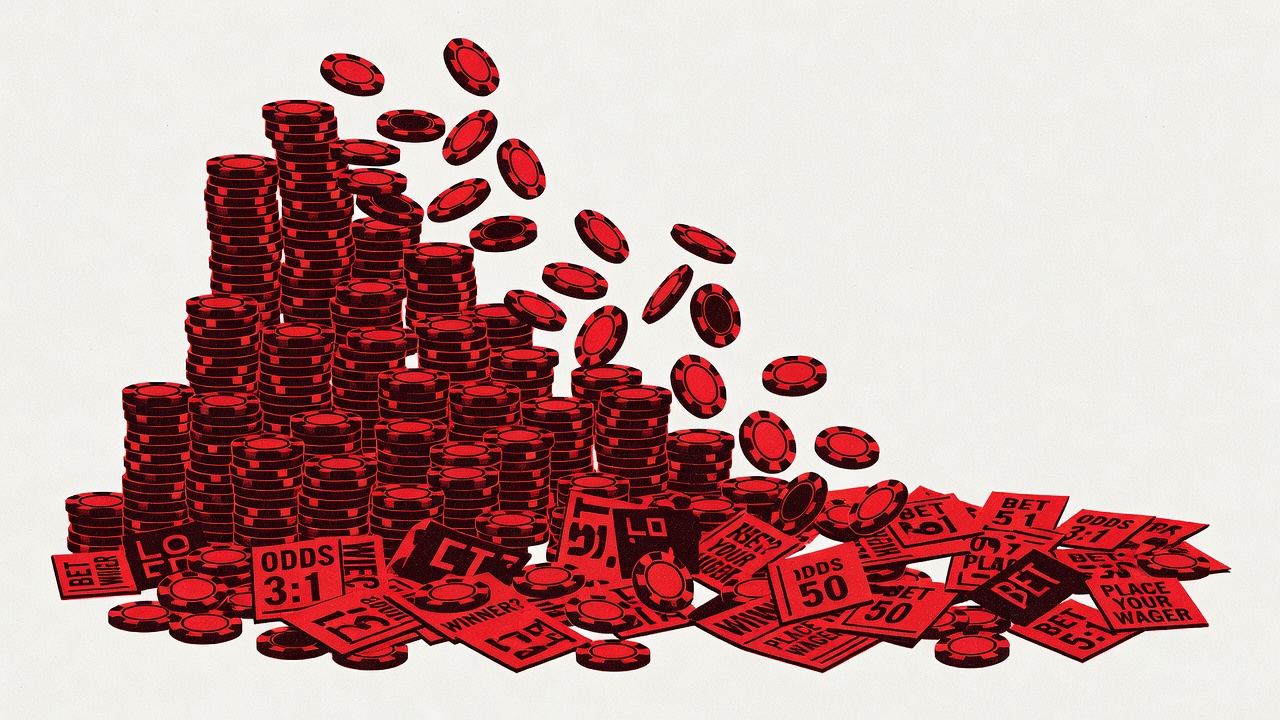
I buy a lottery ticket once a week, always Wednesday. The ticket costs two dollars. What I'm actually buying is seventy-two hours of specific, constrained daydreaming. From Wednesday evening through Friday afternoon, I can think about money without thinking about money. I can imagine a future that feels possible because I hold a legal claim to it, however probabilistically laughable that claim is.
Scorsese's Casino (1995) understands this economics perfectly. The film is about a town that has organized itself around selling exactly that: the experience of imagining a better life through risk, packaged as spectacle, calibrated for addiction.
The genius of the film isn't that it condemns Las Vegas (though it does). It's that it respects the basic human impulse driving the whole machine. Ace Rothstein, Robert De Niro's character, is not playing baccarat to get rich. He's already rich. He's playing because the act of playing, the concentration required, the possibility of loss, produces a sensation that ordinary life cannot. Gambling, in the film, is the only activity that makes Ace feel alive.
That's what every gambler knows and never admits. We're not trying to beat the odds. The odds are fixed. We're trying to buy a moment where the outcome hasn't been decided yet, where we're still in the possibility space. The money is the vehicle. The feeling is the product.
The Architecture of Appetite
Scorsese spent weeks in Vegas during production, watching dealers, croupiers, pit bosses, players. The film is documentary-adjacent in its precision. The casino floor is shot as architecture. Every sight line, every sound design choice, every light placement is optimized to keep the player in a state of managed arousal. Come in at night. The exterior light is minimal. Your eyes adjust to artificial illumination calibrated in the 3000 to 4000 Kelvin range, warm enough to feel safe, cool enough to stay alert. No clocks. No windows. The geometry of the space is infinite; you can't see where the walls are.
This is Ace's kingdom and his prison. He loves it because it works on him the way it works on every other player. He understands the mechanics intellectually. He's immune to them emotionally. He can't be. The whole enterprise depends on the house itself being seduced by the game it's running.
Loss Aversion and the Sunset
The film's great insight is that gambling works precisely because it operates on the margins of desperation. A person with sufficient bankroll that losing is inconsequential cannot be truly hooked. They're just spending money. But a person betting money they can't afford to lose, or betting their dignity, or betting their marriage, or betting their entire identity as a person who knows how to read a room?
That person is buying something. The film watches this transaction in detail. Nicky's girlfriend, played by Sharon Stone, moves through the casino like a woman who understands that her entire social standing is a function of the money flowing through it. She's not gambling. She's gambling with her life. Every bet someone else places affects her odds of survival in that world.
This is what modern slot design has learned from thirty years of behavioral research: the goal is not to make the player wealthy. It's to make the player feel like they're making progress. Near-miss feedback loops, variable-ratio reinforcement, the specific sound design of a win. These aren't bugs in the system. They're the product the player is paying for.
The Terminal Insight
The film ends with Ace as a middle-aged man watching football, living a flat life in ordinary Las Vegas, divorced, cut out of the industry he built. He's safe. He's solvent. He's fundamentally empty. The camera pulls back and he sits in a casino, aged, watching other people buy what he no longer can afford: the sensation of living in a future that hasn't been resolved.
You put two dollars on a lottery ticket because you know the odds. Everyone who plays knows the odds. You're not fighting the math. You're paying the two dollars for permission to imagine that this week, your life changes. That's not irrational. That's economics. The question isn't why people gamble. It's why we've built the entire entertainment industry on the understanding that people will pay for the possibility of a different life, even knowing the cost of that possibility.
Scorsese gets this. The film doesn't judge Ace's hunger for the table. It understands it. That understanding is what makes Casino feel, thirty years later, like the closest a film has come to the actual psyche of the gambler.