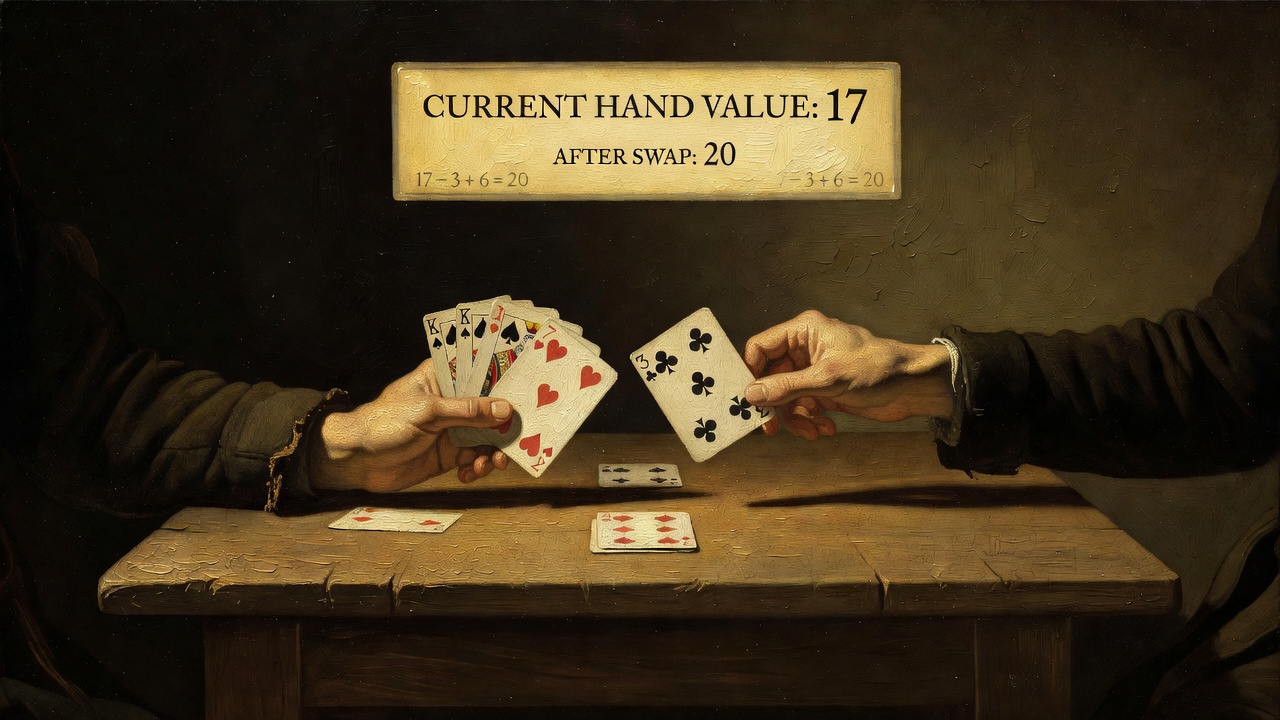
the premise: you get two hands. play them against the dealer. but after you see your cards, you can swap the first card of hand one with the first card of hand two. this changes everything.
in regular blackjack, basic strategy says: always split eights. always double 11 against dealer's weak card. never split tens. blackjack switch breaks these rules because swapping is more powerful than splitting in certain situations.
why swapping matters
you're dealt 8-6 on hand one, 4-8 on hand two. in regular blackjack, you'd hit hand one, double hand two. in switch, you want to think first: what if i swap the 6 from hand one with the 8 from hand two? now i have 8-8 and 4-6. the pair of eights is stronger. you'd split it. the 4-6 stays weak but at least you have position on the better hand.
this is pure optionality value. the swap lets you see the worst outcome before committing. regular blackjack forces you to commit (you've got 8-6, you're hitting or standing before you know what comes next). blackjack switch lets you optimize positioning after information.
the house counters this with rule changes. blackjack push (player and dealer both get 21) now only pushes on dealer 22. if both stand at 21, dealer wins. this costs the player roughly 1.5% in RTP. the game rebalances to around 0.4% house edge (comparable to regular blackjack basic strategy).
the modified strategy
optimal switch strategy is complex because more decisions are meaningful. some rules:
- always swap if it creates a pair (pair value exceeds the two cards separately in most situations)
- swap if it moves you from a soft 16 or worse into a hard 18 or better
- don't swap if it breaks up hard 19 or 20
- swap aggressively when the dealer is showing weak cards (deuce through six) because positioning matters more when you're likely to win
this isn't theoretical. evolution gaming has published blackjack switch strategy charts. the charts are dense. sixty pages of decision trees. the basic strategy in regular blackjack is two pages. the extra complexity comes from swap optionality.
the game design implication
blackjack switch exists because basic blackjack is mathematically solved. the optimal strategy is known. a perfect basic strategy player has no room to improve. they've hit ceiling.
blackjack switch raises the ceiling. a player can play well or poorly. the variance in decision-making is larger. some hands have obvious swaps. some are genuinely close (should i swap this 8-6 into a 7-7 when the dealer's showing a seven?). the answers require thought.
from a provider perspective (pragmatic play, evolution), this makes the game worth streaming. a player making good decisions beats a player making bad decisions by a meaningful margin. skill expression creates viewer engagement. a basic blackjack stream is boring (decisions are mechanical, the outcome is random variance). a switch stream has decision moments.
the provability problem
if you're playing switch on a crypto casino, does provable fairness (the swap, the card reveal, the outcome all recorded on-chain) help you make better decisions?
no. the transparency of the process doesn't improve the strategy. you still need to know when to swap. you still face the same edge (house edge of 0.4% to 0.6% depending on rules). the blockchain just confirms what happened, it doesn't help you decide what to do.
provably-fair is a technically correct claim (the casino hasn't cheated) but strategically neutral (you still have to play well).
the practical upshot
if you're switching from regular blackjack to blackjack switch, expect your winrate to change based on your decision quality. if you're using basic strategy (which translates roughly but not perfectly to switch), you'll lose more than you expect because you're not optimizing swaps. if you study switch strategy specifically, you'll lose less.
the house edge is not a suggestion. it's a mathematical property of the game. optimal strategy reduces it but doesn't eliminate it. the casino takes roughly 0.4 to 0.6 percent of all money wagered, in the long run, as player edge. no amount of good play beats that.