The Return-to-Player percentages advertised for blackjack and slot machines appear, on the surface, to measure identical concepts. Both describe the proportion of wagered money that the game returns to players over a specified period. Both range from roughly 92 percent to 98 percent in regulated jurisdictions. The similarity is superficial. The two calculations operate under entirely different premises, and understanding the distinction is essential for anyone who gambles with any seriousness.
Slot machine RTP derives from simulation or empirical observation spanning millions of spins. A slot machine with 96 percent RTP is engineered such that, over infinite spins, the apparatus will return 96 pounds for every 100 pounds wagered. This characteristic gets embedded into the algorithm. Participants lack influence over results. Patrons cannot enhance their odds. Each spin carries identical probability of success. The RTP is therefore a full and meaningful measure of player outcome. Given ample time, a bettor on a 96 percent RTP machine will lose currency at a predictable rate. The mathematical expectation stays exact.
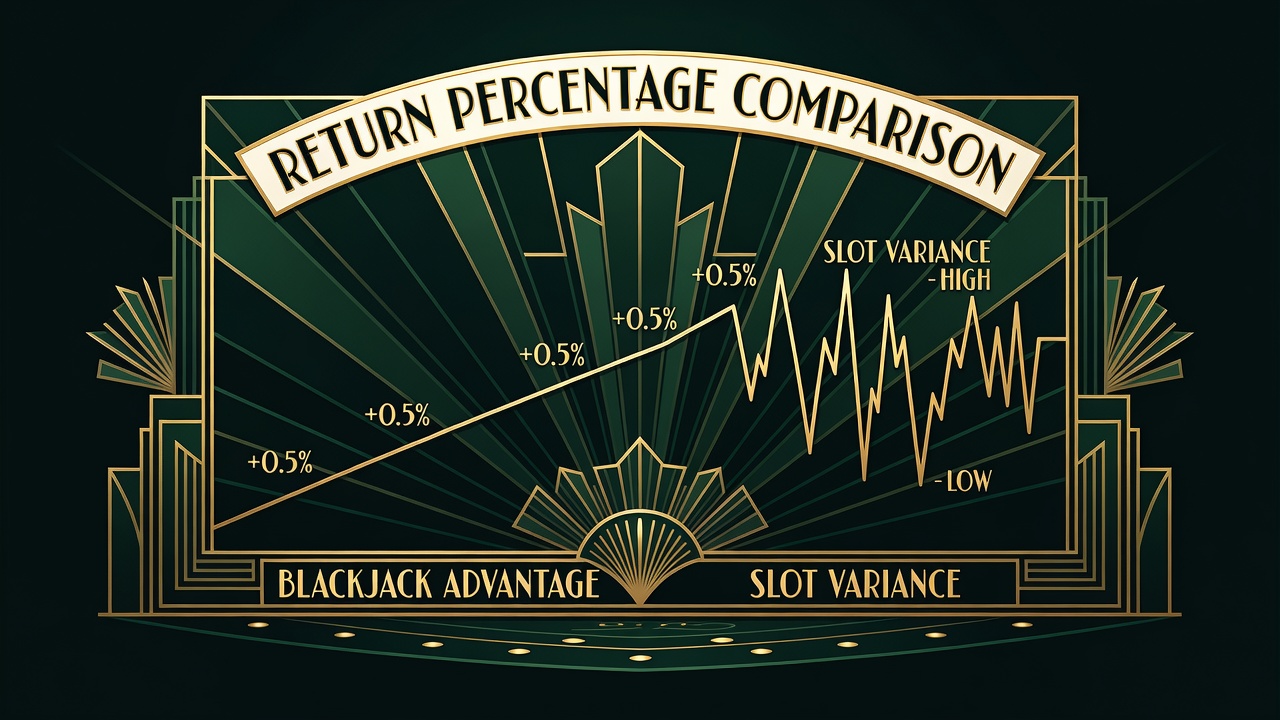
Blackjack RTP is calculated under radically different assumptions. The standard figure cited, typically 99.5 percent for a game with favourable rules, assumes that the player knows and follows basic strategy perfectly. If the player does not follow basic strategy, the RTP changes. If the player makes suboptimal decisions, the player's expected loss increases. The RTP is therefore not a property of the game alone. It is a joint property of the game and the player's decision-making.
The Decision-Making Variable
In blackjack, the bettor elects whether to hit, stand, double down, or split. These selections fundamentally affect outcomes. Basic strategy prescribes the mathematically superior choice in each scenario. A participant knowing and applying basic strategy achieves the 99.5 percent RTP figure. A bettor deviating from basic strategy achieves inferior RTP. A participant making chronically poor selections might realize 95 percent RTP or below. The game proper has not shifted. The regulations remain constant. What evolved is the participant's selection caliber.
This is not true of slot machines. A slot machine with 96 percent RTP will deliver 96 percent RTP whether the player is a novice or a professional gambler. The player's intelligence, experience, or knowledge cannot improve the game's outcome. The player pulls a lever. The machine spins. The machine decides whether the player wins. No skill applies.
The British Gambling Commission, in its guidance on advertising gaming machines, requires that RTP disclosures specify that the figure assumes correct play. Few casinos or online operators emphasize this caveat. The player sees 99.5 percent RTP and assumes the game returns that percentage regardless of play quality. This is misleading, though technically accurate.
Blackjack RTP is conditional. Slot machine RTP is unconditional. This difference is the foundation of all other differences.
The Implication for Long-Term Play
A player gambling thirty hours on slot machines will experience RTP close to the advertised figure. The player gambling thirty hours on blackjack might experience vastly different RTP depending on decision quality. A novice blackjack player, making intuitive but suboptimal decisions, might experience 94 percent RTP. A trained basic strategy player might experience 99.5 percent RTP. Both are playing the same game. The outcomes differ by more than five percentage points.
For the casino, this distinction carries profound business implications. A casino offering slot machines can reliably predict player loss. A casino offering blackjack must account for variation in player skill. This is why casinos often offer better odds on blackjack than mathematical precision would dictate. The casinos understand that the average player will not follow basic strategy perfectly, and that the average player's errors will generate house profits exceeding the nominal house edge. The apparent generosity of blackjack odds is actually an acknowledgement that the average player will make the odds generous, through poor play.
Regulation and Advertising
Regulatory authorities in European jurisdictions now require clearer disclosure of what RTP means in different game contexts. The UK Gambling Commission's 2021 guidelines specify that blackjack operators must disclose that advertised RTP assumes perfect basic strategy. Few operators emphasize this. Marketing departments prefer language like "up to 99.5 percent RTP" because the player reads this as unconditional promise, when the promise is actually conditional on knowledge and execution.
Slot machine operators face identical regulatory requirements. However, the caveat is less important because slot machine RTP is unconditional regardless of how the caveat is worded. A player cannot improve slot machine outcomes through skill or knowledge. The regulatory disclosure matters primarily for transparency and fairness of advertising. The player's practical outcome is unaffected by whether the disclosure is prominent or buried.
For the individual gambler, the distinction matters enormously. Blackjack offers the possibility of improving expected value through disciplined play. A player who learns basic strategy can reduce the house edge from 2 to 4 percent (depending on ruleset) to 0.5 percent. The player has agency. Slot machines offer no such opportunity. The player's expected loss per pound wagered is fixed at the design level. The player cannot improve it. The player cannot worsen it. The player can only accept it or refuse to play.
This fundamental distinction rarely appears in marketing materials, industry discussions, or player education. The industry treats all RTP figures as equivalent. They are not. Blackjack RTP is a ceiling that players can fail to achieve. Slot machine RTP is a floor that players cannot improve upon.