You want to know about card counting? Start with a man named MIT, except that's not a man. In the mid-1960s, a group of mathematics students from that institute showed up at Atlantic City casinos like they owned the place. They didn't. But for a brief moment in American gambling history, they understood something about blackjack that the casinos had overlooked. The story everybody tells about card counting is not the story that happened.
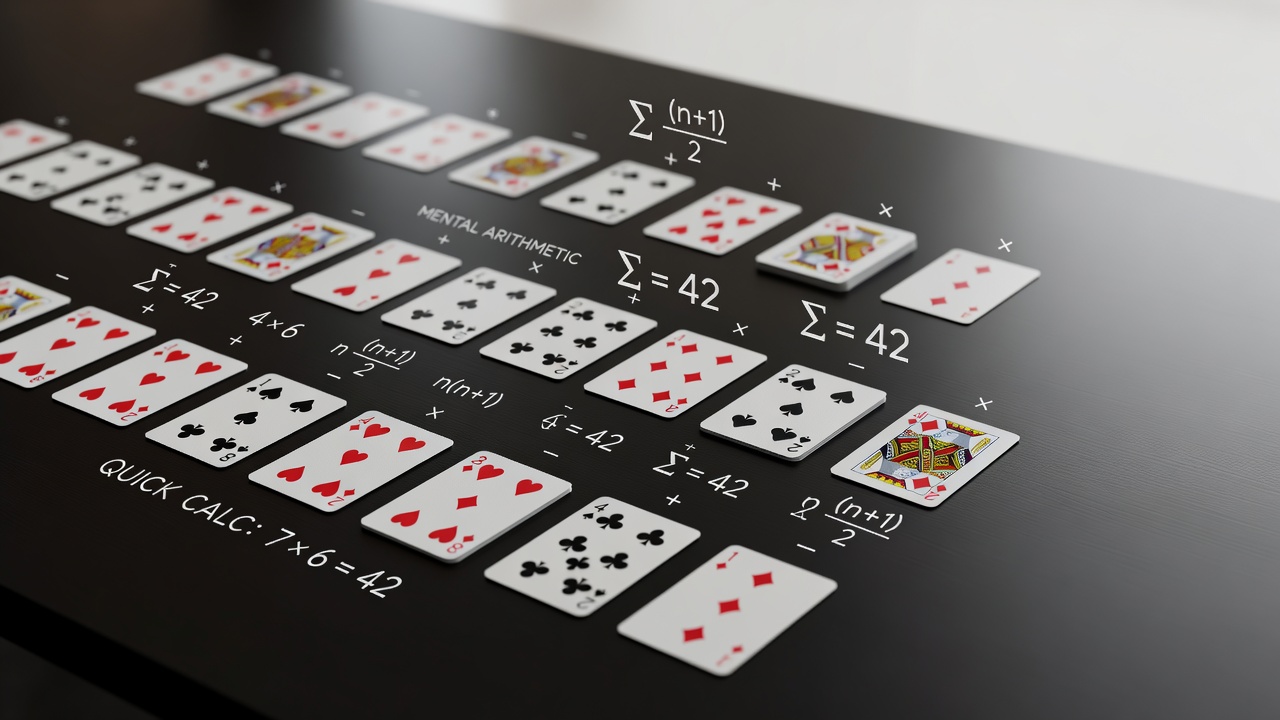
The real story is smaller. It's about attention. About waiting. About the mathematics of what remains in the shoe, and whether that mathematics made playing certain hands worth the risk. A card counter doesn't "guess" what's coming. He counts what has left the deck. The deck has only so many cards. The cards that are gone cannot appear again. This fact, obvious on paper, proved remarkably consequential in the sticky heat of a Atlantic City night.
When the casinos finally figured out what those MIT kids were doing, the casinos did what casinos do. They changed the rules. They dealt more shoes. They watched more carefully. They hired men to watch for men who watched. The entire apparatus of casino security, much of which exists today, emerged not from any crime or violence but from this simple competitive fact: people were thinking harder about blackjack than the house expected.
Here's what card counting actually does. It gives the counter information. The information is this: when the shoe is rich in high cards, the counter has a small advantage. When the shoe is poor in high cards, the counter does not play. When the advantage is there, the counter bets more. The advantage is not large. We are talking about 1.5 percent, maybe 2 percent. You can make money for a year and then lose it in one terrible week. You need a bankroll that can absorb variance. You need discipline about when you play and when you walk away. You need, essentially, to be boring.
The Mind Behind the Cards
Talk to a card counter and you will rarely hear the breathless language of casino mythology. The counter is an accountant with a memory. He notices. He computes. He acts on the computation. He does not get excited. He cannot afford excitement. Excitement causes errors, and errors cost money. The famous counters all had this quality: a kind of grinding competence. They were not wild men. They were not savants. They were careful.
The first great public case was Lawrence Revere, a man who thought carefully about the numbers and then wrote a book about it. When the casinos read that book, they understood immediately that the jig was up. A card counter can work if casinos do not know he is counting. Once they know, they pull him out. They ban him. This happened. It is still happening.
The MIT students got rich in the way that people get rich from casinos. They found an edge, they exploited it, they drew attention, and they left before the casinos closed the gap. One of them, a brilliant kid named Bill Kaplan, organized the operation with the precision you would expect from an MIT student. They pooled their capital. They divided labor. They rotated players so the casinos would not see the same faces too often. Kaplan was not a gambler. He was an engineer, and he engineered a blackjack syndicate.
The real story of card counting is not that it is unbeatable. The real story is that it is boringly, methodically exploitable, until the casinos close the door.
They made money. They made very good money. And then it stopped working because casinos are smarter now. They use continuous shufflers in some casinos. They employ specialists who watch for counting patterns. They can spot a person who doubles his bet when the count is positive. This is not difficult to spot if you are trained and you are looking for it.
The lasting truth about card counting is that it requires three things the movies never show: patience that borders on torture, a bankroll large enough to weather brutal variance, and the discipline to walk away when you are tired or frustrated or human. The card counter is not a character from a heist film. The card counter is a man doing mathematics under pressure, knowing that his advantage is temporary, and knowing that the moment the casinos decide to look, his advantage becomes a liability. He is rare. He is unglamorous. He is entirely real.