The Ubiquity of Alea
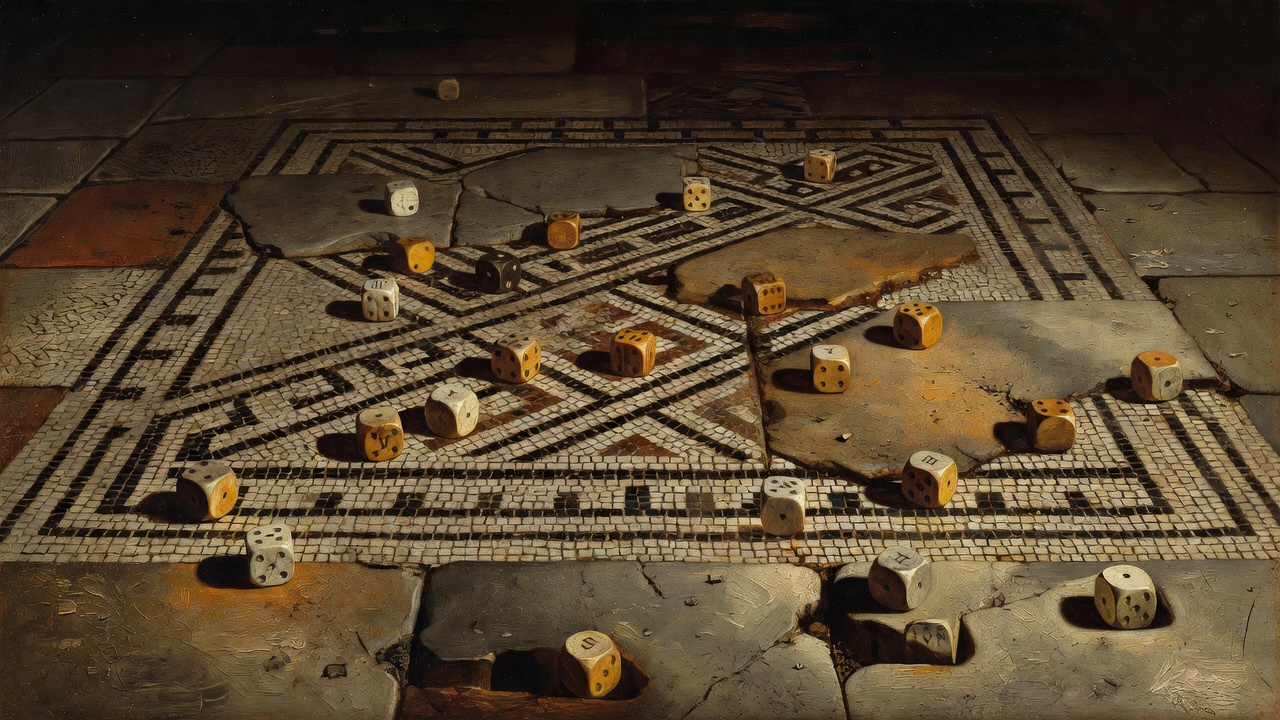
Alea (dice gambling) was omnipresent in Rome from the 1st century BCE through the fall of the Empire. Archaeological evidence shows dice from taverns, estates, and military barracks. Pliny records that soldiers gambled their armor and armor for stakes. The poet Horace describes compulsive gamblers losing their family wealth in a single night. Augustus himself banned public gambling, yet coins exist showing Augustus playing dice privately.
Prospect theory predicts that people feel loss more acutely than equivalent gains. A Roman losing 100 denarii felt that loss 2-3 times more sharply than the pleasure of winning 100. Yet Romans gambled anyway, knowing the expected value was negative. Why?
Status and Social Signaling
Gambling was a status play. A wealthy patrician gambled for high stakes not to win (he expected to lose) but to signal that the loss was inconsequential. Gambling ostentatiously was equivalent to modern conspicuous consumption: it demonstrated resources sufficient to waste. Pliny records an emperor who bet his family estate on a single hand. He lost. The loss was financially irrelevant to him; the signal was everything.
Poorer Romans gambled at taverns for stakes they could not afford to lose. This is where modern parallel emerges: loss aversion collides with the hope of status elevation. A lower-class Roman might lose his month's wages on a dice roll, knowing statistically he would lose, but hoping irrationally that he might win enough to change his social position.
The Behavioral Trap
Roman gambling history shows what psychologists call the "hot hand fallacy" and "gambler's ruin." After a losing streak, players increased bet sizes to recover losses. Juvenal describes a gambler losing everything, then borrowing to gamble more, convinced that one more roll would restore his fortune. The expected value was fixed; the bet sizes spiraled. This is modern chasing behavior.
Mental accounting played a role too. Romans distinguished between "money I can afford to lose" (often framed as stakes given to slaves or friends to hold) and "my actual wealth." Once the money was reframed as "stakes," the psychological loss aversion weakened. The money felt already spent, risk-adjusted.
The Bans That Failed
Augustus banned public gambling in Rome (excluding certain festivals). The ban was enforced inconsistently and evaded constantly. Gambling moved indoors. Establishments served food and wine, with dice available in back rooms. By Nero's reign, the ban had eroded entirely.
Diocletian banned gambling for soldiers and lower-ranked administrators (but not officers). Soldiers gambled anyway. The regulation created a market for underground games and for bribes to authorities. Larger social lesson: prohibition of a psychologically persistent behavior (loss aversion fighting hope, social signaling via risk-taking) fails unless the underlying appeal is eliminated. Rome never did.
Why the Repetition?
Societies repeatedly ban gambling because the political pressure to "protect" citizens from their own bad choices is strong. But the behavior persists because rational economic actors do not model it correctly. Romans thought bans would work. Modern societies think the same. Both underestimate the power of mental accounting, status signaling, and hope bias.
What differs: modern societies have data. We know loss aversion exists. We know that chasing losses is irrational but predictable. Yet we still design regulation around the assumption that it won't work. The ban is political cover, not behavioral intervention.
Rome's legacy is clear: gambling cannot be eliminated by law in a society that tolerates economic risk-taking in other domains. The inconsistency is visible to everyone. The only effective controls are either total prohibition of all risk (impossible in a market economy) or acceptance plus regulation of harm. Rome chose neither and got both widespread gambling and ineffective bans.