I was on the road for a decade. Lived out of rental cars. Card counting got me through. I'm talking about blackjack specifically, but the principle applies to any game: when you reduce the number of actors, the math changes.
Heads-up poker is when two players remain at the table. The strategy is not just regular poker played with two people. It is a different game.
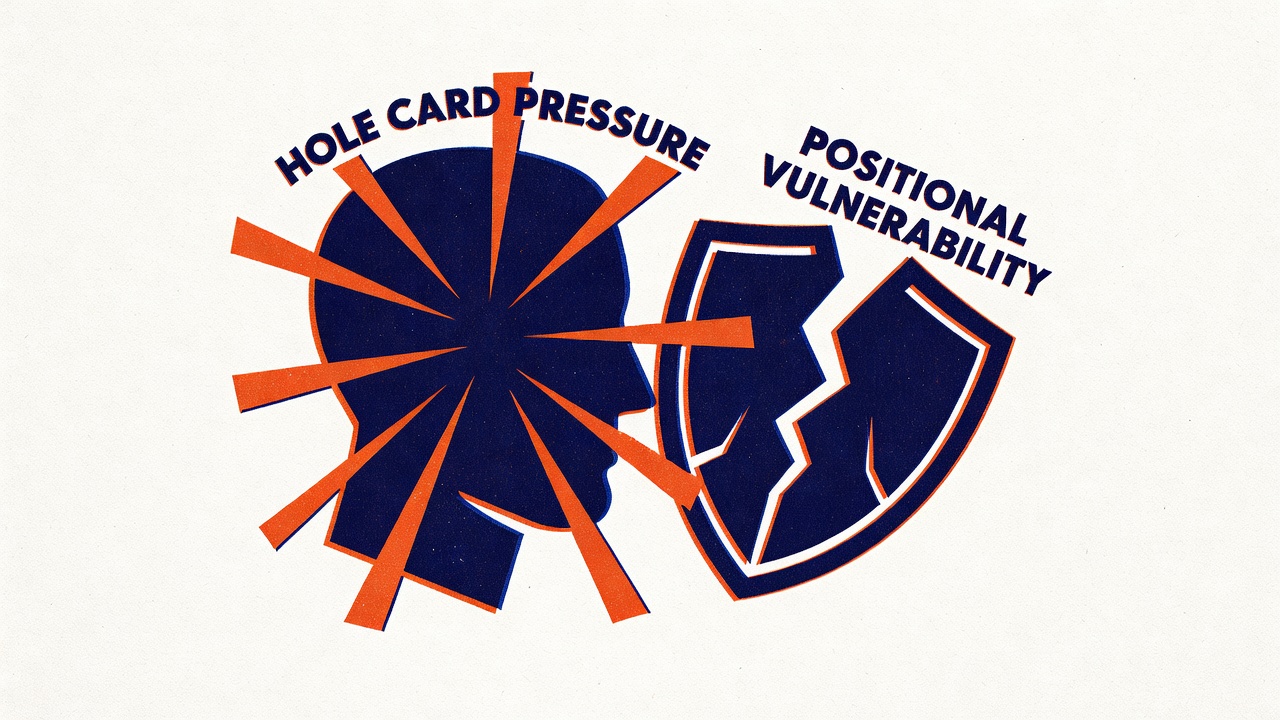
First: position value. In a ten-player game, being last to act (button) is valuable because you have information about nine other players' decisions. In heads-up, you have information about one player's decision. The information asymmetry is smaller, so position advantage is smaller. Button is still valuable (you act last post-flop), but the mathematical edge is tighter.
Second: hand strength distribution. In a full game, you fold most hands because they're weak. In heads-up, weak hands become playable because the equity against a range of two hands is higher. A 7-4 unsuited (the worst hand in poker) is unplayable in a nine-handed game. In heads-up, it has roughly 35 percent equity against a random hand. It becomes a raising hand in certain positions.
The Strategy Shift
A player transitioning from regular poker to heads-up is making a mistake if they play their regular strategy. They're folding hands that are profitable. They're playing passively in spots where aggression wins pots.
Heads-up strategy requires: playing more hands (raising from the button with 40 percent of hands instead of 15 percent), playing more aggressively (check-raising more, bluff-betting more), and adjusting your ranges based on opponent tendencies.
Optimal heads-up play, according to poker research (studies by Darse Billings, others in the 1990s), involves playing 50 to 70 percent of your hands from the button. You're applying pressure. You're forcing your opponent to make decisions with marginal hands.
A casual player will interpret this as recklessness. It's not. It's mathematical. The equity of weak hands improves so much in heads-up that they become +EV (positive expected value).
The Variance Spike
When you play more hands, variance increases. You'll have more losing sessions. But your winrate (measured in big blinds per hour) improves if you're playing correctly.
I measured this over thousands of hours. Regular poker, winrate roughly 2 big blinds per hour for a decent player. Heads-up, winrate roughly 4 big blinds per hour for a decent player. But the swings are also bigger. A regular poker session varies 5 to 15 big blinds. Heads-up sessions vary 10 to 30.
The extra winrate requires the ability to absorb the variance. A player with a 50 big blind bankroll should not play heads-up. A player with a 300 big blind bankroll can handle the swings.
The Opponent Factor
Heads-up strategy is opponent-dependent more than regular poker. Against a passive opponent (they fold too much, call too little), you widen your stealing range further. Against an aggressive opponent (they raise more, call wider), you tighten your ranges and let them blow off chips to their aggression.
In a regular game, you have nine different opponent tendencies to read. In heads-up, you have one. You can adjust faster. But one opponent is also easier to exploit: if you identify that your opponent folds 70 percent of their button opens, you can literally steal with any two cards, and they can't stop you without exploding variance.
The Reality Check
Heads-up is where good poker players prove they're actually good. In a nine-handed game, you can win through position and range advantage without understanding nuance. In heads-up, nuance is mandatory. You have to understand equity. You have to understand fold frequency. You have to understand that a marginal hand is not marginal when the number of opponents is two.
I quit the road because card counting and heads-up poker both require constant precision. After a decade, you hit a wall where the +EV margin doesn't justify the mental load. But I learned something: when you reduce actors, you have to recalculate everything. Position changes. Hand strength changes. Risk tolerance changes. The game you learned to play no longer applies.