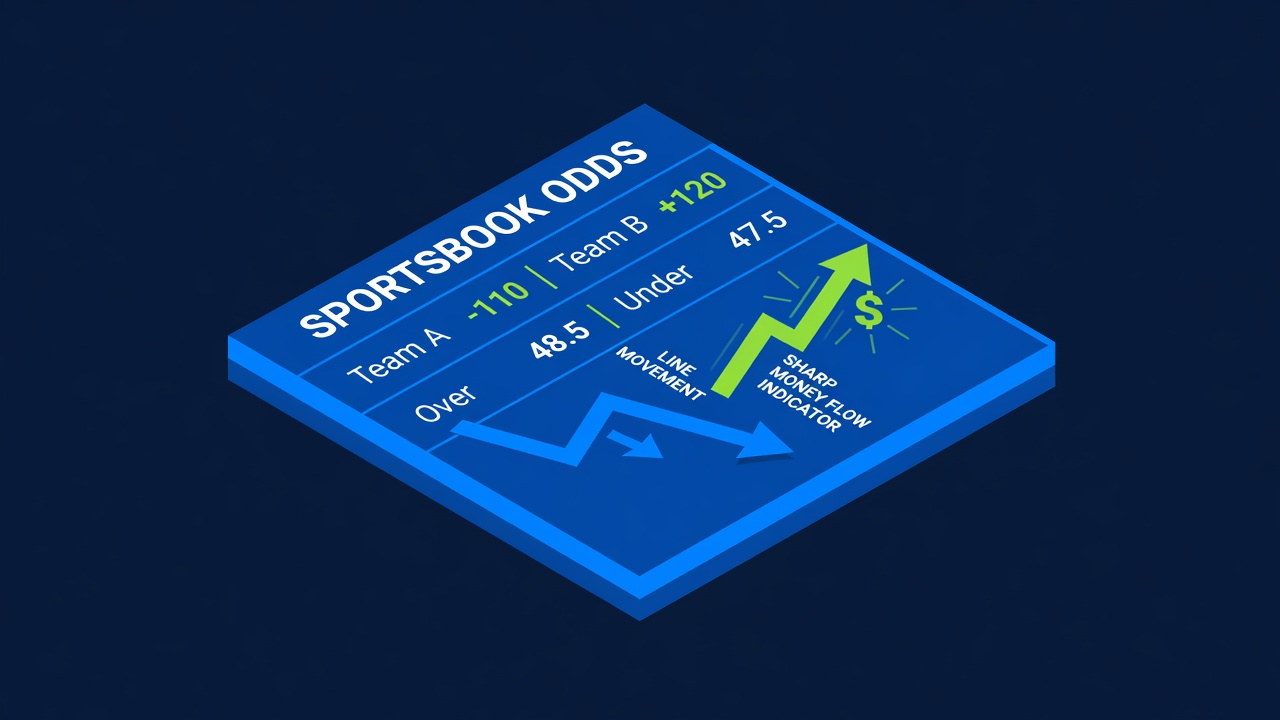
The point spread in an NBA game is set to balance action. If the Warriors are playing the Grizzlies, Vegas knows Warriors are better. They set the spread at, say, Warriors minus-7. This means a Warriors bettor needs them to win by more than seven to cash. The spread is designed so that roughly equal amounts of money come in on both sides.
The theoretical market would instantly reflect all available information. Player injuries, rest advantages, weather (for teams traveling), coaching changes, recent performance, advanced metrics. A perfect market spread would be unfair only by random chance.
The actual market has structural inefficiencies that repeat. First: public perception lags. A Warriors team that just lost two games will have a higher spread than their talent suggests, because casual bettors weight recent results heavily. This is the recency bias documented extensively in behavioral finance literature. Second: narrative bias. A team that's "hot" will be overbet. A team that's "cold" will be underbet, regardless of actual propensity changes.
A data-driven bettor identifies when these inefficiencies appear. They look for games where the sharp consensus (the line favored by professional bettors) diverges from the public consensus (where the money is flowing). They look for teams with underrated depth, or coaches who historically perform well in specific situational spots.
The Measurable Edge
Consider the Warriors again. Their internal spread (what their own analytics suggest) is Warriors-minus-6.5. The public has pushed the line to Warriors-minus-8 because casual bettors love the Warriors brand. A sharp bettor, seeing this divergence, bets the Grizzlies at plus-8, confident that the true spread is nearer minus-6.5. If the Warriors win by seven, they push. If by six or fewer, they win.
This edge is real but small. Repeated across many games, it compounds. A bettor with a 52 percent hit rate (identifying spreads that are a half-point off) makes modest but consistent money.
The catch: identifying the true spread requires data. Injury reports, rest schedules, head-to-head metrics, advanced stats (RAPM, BPM, predicted net ratings). It's not intuition. It's mathematics.
The Behavioral Trap
Most casual bettors are not looking for spread inefficiency. They are looking for validation. They have a team they like. They want that team to win. They bet on them. If they lose, they explain the loss (bad call, injury, bad luck). If they win, they reinforce their confidence in the team. They have no expectation of edge. They are purchasing the feeling of having skin in the game.
This is called problem gambling behavior in clinical terms. It's also called normal sports betting behavior in practical terms. The bettor is not trying to beat the market. They are trying to extend engagement with the sport.
A data-driven bettor is doing something entirely different. They are indifferent to the team. They want to know whether the current line overvalues or undervalues the public's beliefs about the team's probability of covering. They are betting on the market's psychology, not the game itself.
The Edge Measurement
If a model predicts a 55 percent chance the Warriors cover a minus-7 spread, and the historical data supports that model (backtested over three seasons, across different coaches and injuries), then repeated betting at those odds builds positive expected value.
The Kelly Criterion, developed for gambling optimization by John Kelly in 1956, suggests the bet size should be proportional to the edge. A 2 percent edge (55 percent hit rate on even-money odds) suggests a very small bet. The bankroll allocation matters more than the individual outcome.
Most casual bettors cannot compute this. They bet fixed amounts regardless of confidence. A data-driven bettor adjusts position size based on confidence level.
The Realistic Limitation
The NBA has sharp bettors on both sides of every line. The market is efficient in the aggregate. Individual inefficiencies exist (the public overweighting recent performance, or brand bias) but they're small and fleeting. A bettor needs statistical rigor and emotional discipline to exploit them. Most don't have either.
The research is clear: casual sports bettors lose money over time. Professional bettors, using data and modeling, can maintain slight edges that accumulate to profit. The difference is not luck. It is the difference between testing beliefs against reality and trusting your gut.