April 14, 2008. Atlantic City. A blackjack player named Marcus sat at a Borgata table. He was dealt an ace. He split it. He received another ace. The dealer told him he could not split again. He accepted it and played the hand.
What he didn't understand: he had just lost potential value. An option that could have been worth money had been removed by the house rule.
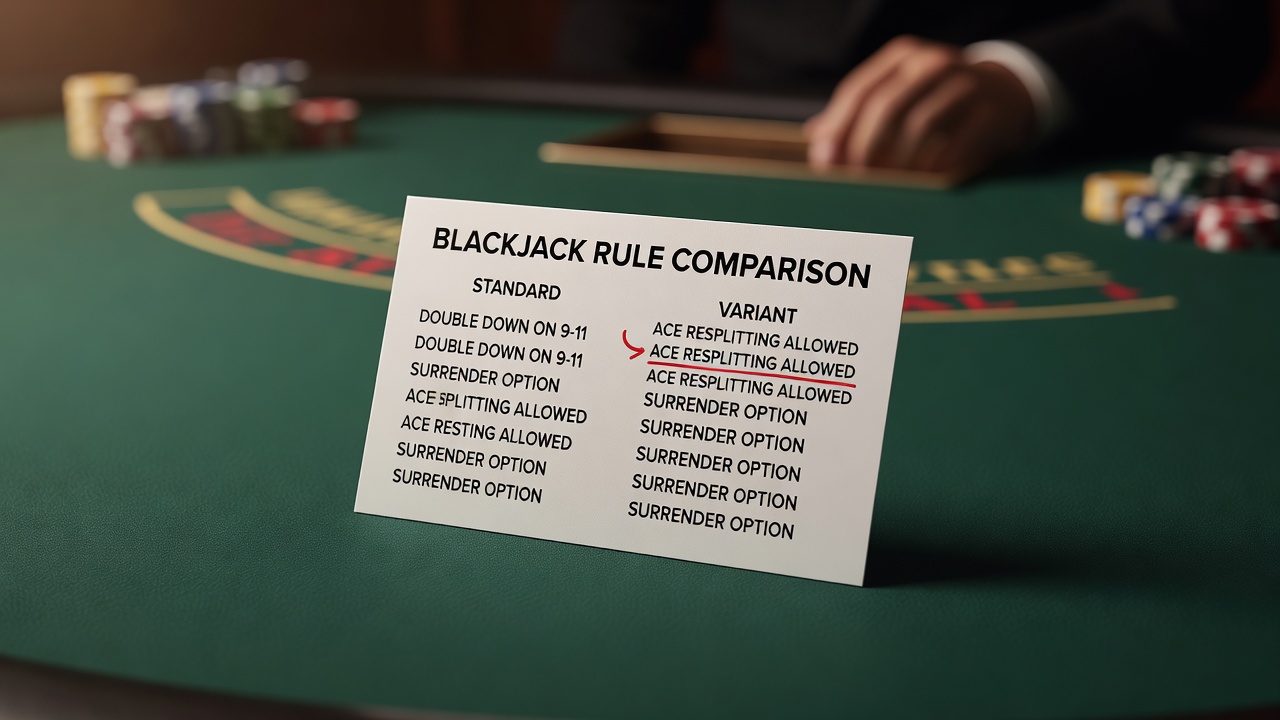
Resplitting aces is the technical term for: when you split aces and receive another ace, you can split that ace again. Some tables allow it. Most don't.
The Mathematical Advantage
Aces are the best hand in blackjack. An ace plus any ten-value card is blackjack (21, pays 3:2). An ace in a split hand gives you the possibility of blackjack on each split hand.
If you split aces and receive an ace on the first split, you now have the option to split again. If the table forbids it, you're stuck with a single split. If the table allows it, you can pursue the option.
The advantage is small (roughly 0.1 to 0.2 percent of your bet if you're able to resplit) but real. A table that forbids resplitting is slightly less favourable than a table that allows it.
Which Tables Offer It
Evolution Gaming tables often allow resplitting. Pragmatic Play tables vary. Many physical casinos don't allow it. European casinos are more likely to allow it than U.S. casinos.
When evaluating a blackjack table, check the rules. The differences are small individually but compound over thousands of hands.
The Rule Variation Matrix
Blackjack house edges vary based on:
- Deck composition (single deck vs six-deck vs eight-deck)
- Dealer hit/stand rules (hit soft 17 or stand)
- Doubling rules (double on any two cards, or only 10-11)
- Splitting rules (can you resplit)
- Surrender options (can you fold a hand after seeing the dealer's card)
A table with six decks, dealer hits soft 17, double on 10-11 only, no resplitting, no surrender: house edge roughly 0.6 to 0.7 percent.
A table with six decks, dealer stands soft 17, double any two cards, resplitting allowed, surrender available: house edge roughly 0.4 to 0.5 percent.
The difference is small. Over 1,000 hands, it adds up to 2 to 10 dollars. But it matters.
The Strategic Implication
Basic strategy for splitting aces assumes that you can resplit. If you can't resplit, your strategy should adjust (you should be slightly more conservative about some split scenarios).
Most players don't know this. They apply basic strategy regardless of the house rules, which means they're not optimizing against the actual rule set.
The Honest Assessment
Resplitting aces is a detail. It is not the difference between a winning and losing strategy. But it is the difference between a slightly better table and a slightly worse table.
A player who compares tables before choosing one (checking the rule set before sitting) will make better long-term decisions than a player who sits at the first available seat.
Most players don't compare. They sit. They play. They lose to the house edge without understanding that some of the edge comes from rules they could have avoided by choosing a different table.