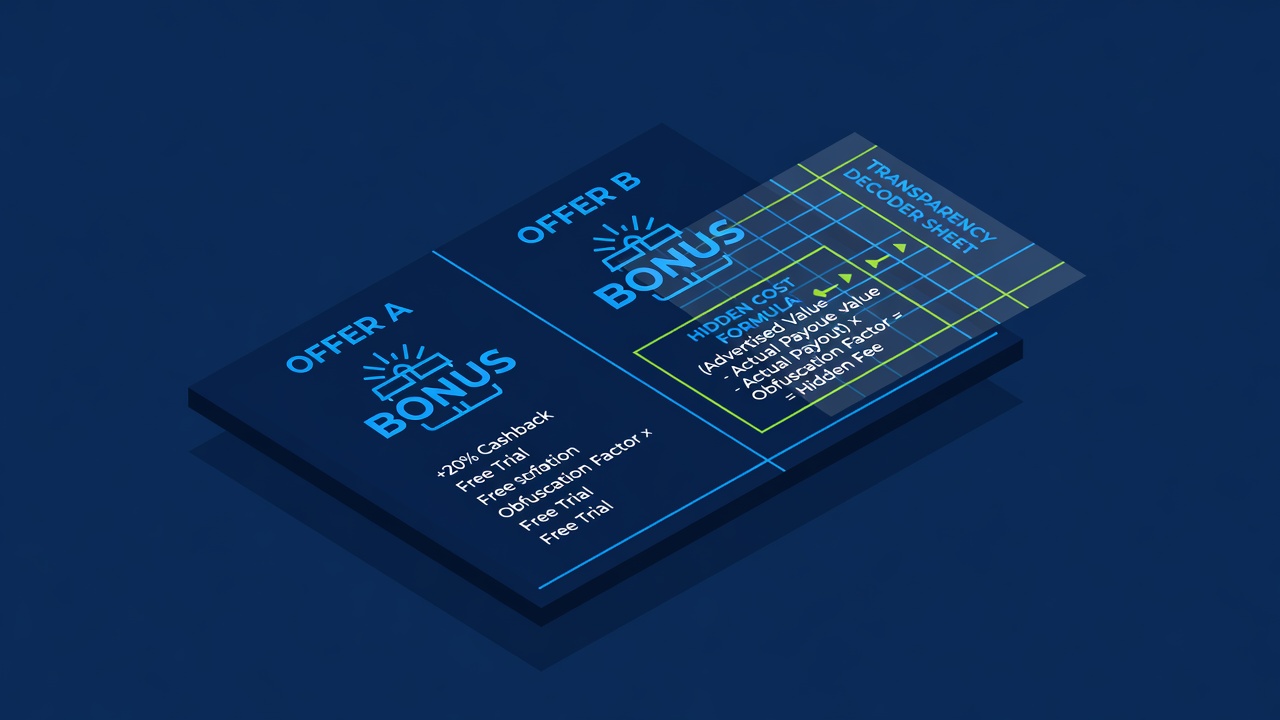
Let's start with what casinos want you to think: a 100% match bonus is objectively better than a 50% match bonus. Twice the free money. Clearly better. Except the magic phrase that cancels that arithmetic lives in the fine print, the same fine print that no one reads but everyone agrees exists: "applies to slots only." This is the essential move of casino bonus marketing. Create a halo of generosity around a number, then wall it off with restrictions the player won't notice until they've already mentally spent it.
For table games specifically, the bonus landscape becomes a study in behavioral economics. A player walks in thinking they want "free money." What they get instead is a constrained choice between bad options, ranked by degree of badness.
The Deposit Match Trap
Start with what seems simplest: the deposit match. You put in 100. The casino adds 100 to your account. The catch (and it's always there) is the playthrough requirement. Most table game bonuses carry a playthrough of 20x, 30x, sometimes 40x. Your deposit plus bonus must be cycled through the games before you can withdraw.
This is where the math becomes important. You have 200 (your 100 plus the matched 100). You need to play 4,000 (20x playthrough). The house edge on blackjack sits around 0.5% to 1% depending on basic strategy adherence. On roulette, it's 2.7% (European) to 5.26% (American). Play 4,000 in blackjack and you can expect to lose about 20 to 40. Play 4,000 in roulette and you can expect to lose 108 to 210. The "free" money was always a loan from the casino, collateralized by the mathematical certainty that you'll lose some of your original deposit meeting the playthrough.
The match bonus makes financial sense only if (1) you were going to deposit anyway, and (2) the playthrough threshold is low enough that your expected loss in meeting it is less than the bonus amount itself. For most casual players, neither condition holds.
No Deposit Bonuses and the Cost of Freedom
No deposit bonuses sidestep the deposit problem entirely. The casino gives you 20 to play with, attached to no deposit of your own. Sounds generous. Is genuinely different. The downside: these bonuses are typically tiny (20 to 50 in chip value) and carry aggressive playthrough requirements, often 50x or higher. You're asked to run a smaller amount through a longer wringer.
For table games, no deposit bonuses are almost never worth the time. A 30 playthrough on a 30 bonus gives you 900 to burn through at a game with a 1% house edge. You can expect to lose roughly 9. The casino is offering you a 1:1 shot at turning 9 of expected loss into a small upside if you get lucky. Some players will win. Most will end up confirming the house edge.
The Slow Rollback
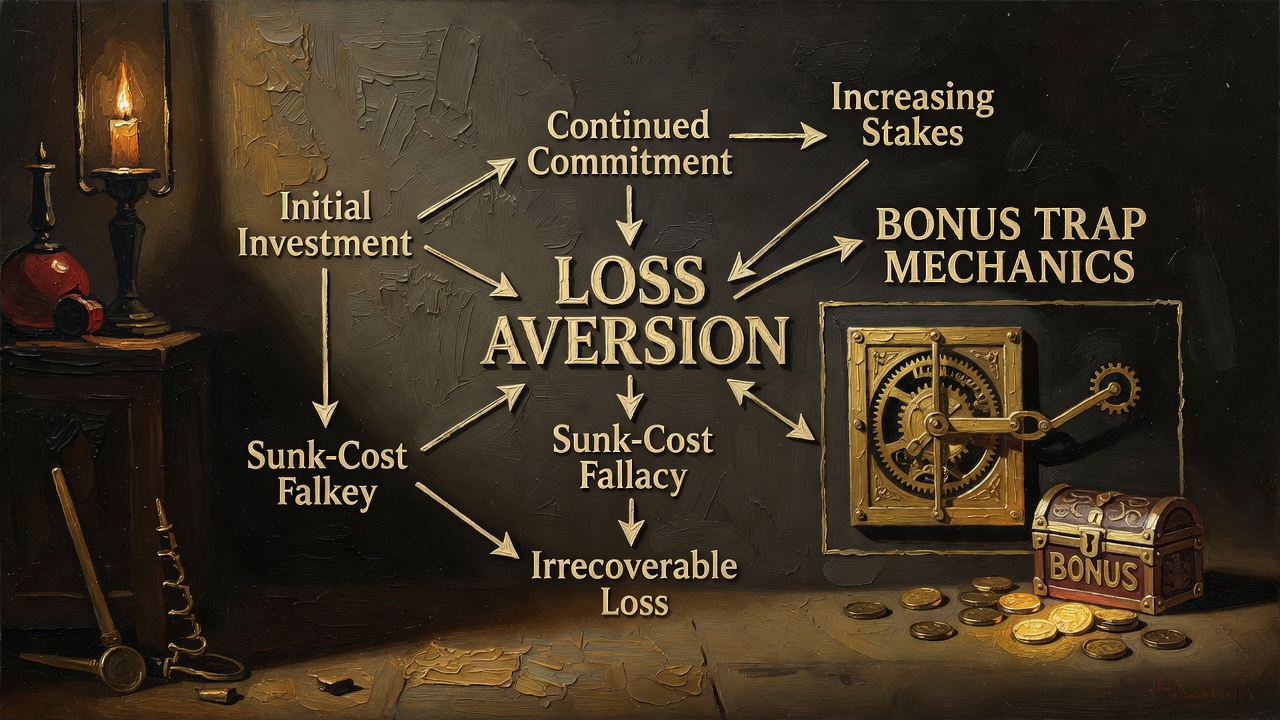
Casinos have gotten clever about playthrough mechanics. Rather than blocking withdrawal until the requirement is met, many now take the bonus amount back incrementally as you lose. Play 1,000 of your 4,000 required playthrough and the casino claws back 250 of the bonus. The math works the same (you're fighting the house edge across 4,000 total wagered), but it feels different. It feels like you're earning it back. You're not. You're just experiencing the loss more granularly.
For baccarat or blackjack, where table minimums may be 25 or higher, playthrough requirements become a sunk-cost problem. You're not choosing to play because you want to play baccarat. You're playing because you have to clear a bonus. The financial frame has collapsed. You're now in territory where the casino captures all the behavioral asymmetry: you're motivated to stay in action longer than you normally would be.
Reading the Matrix
The only bonus worth taking as a table game player is one that (1) has a playthrough requirement below 10x, (2) applies to your target game (blackjack, baccarat, roulette), and (3) exists alongside live dealer tables that are actually licensed and audited (UKGC, MGA, Curaçao eGaming entities). And even then, the bonus is worth taking only if the playthrough-adjusted expected loss is lower than your expected action anyway.
Most table game bonuses fail this test. They're designed to feel like generosity while functioning as a tax on new players. The marketing copy will always highlight the free money. The math will always prove that generosity was never the point.