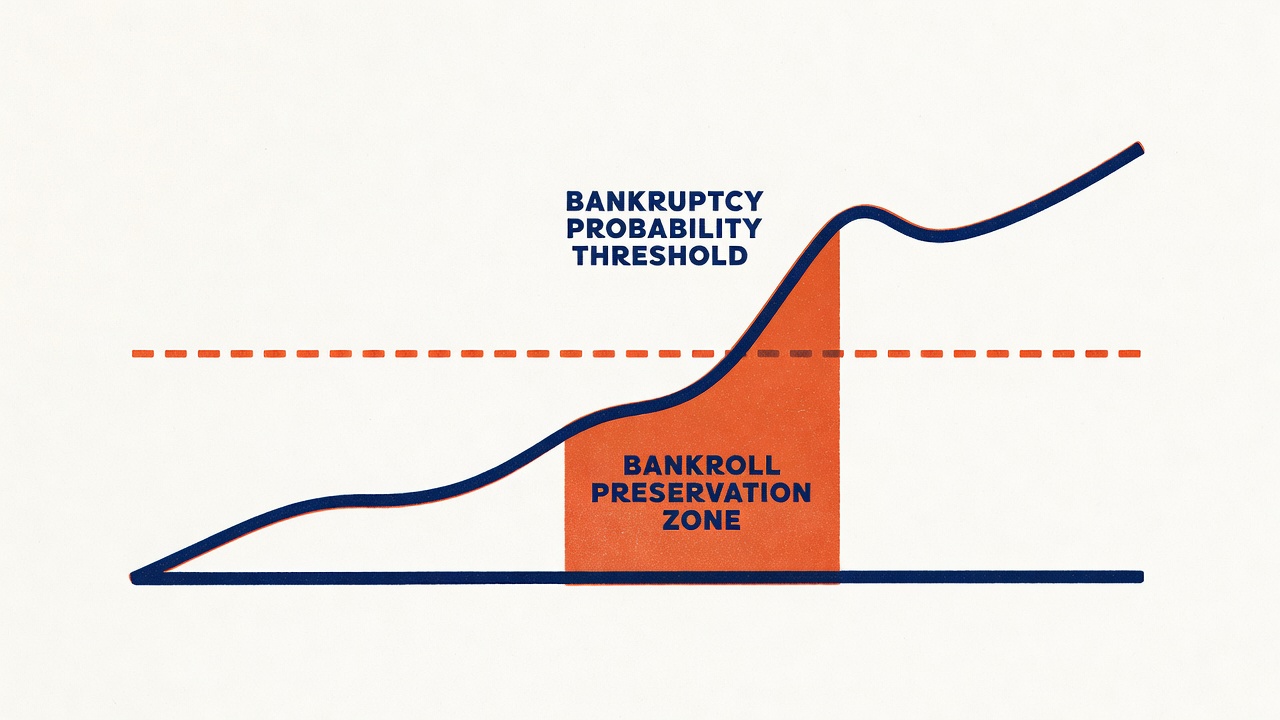
Risk-of-ruin denotes the probability that a gambler, beginning with defined capital, will experience total depletion prior to achieving profit targets. This anchors gambling mathematics. Calculating this metric requires three parameters: opening bankroll magnitude, game advantage margin, and per-bet stake amount. These inputs yield probabilistic forecasts for eventual insolvency.
To illustrate: A patron enters blackjack with one thousand dollar capital. The intended wager is fifty dollars per hand. Blackjack using optimal technique carries approximately 0.5 percent house advantage. The inquiry becomes: What likelihood exists the patron exhausts capital before exiting profitably? Risk-of-ruin formulas address this inquiry.
The Mathematics of Risk of Ruin
Risk-of-ruin computation employs probability mathematics and the classical "gambler's ruin" principle. Formulation hinges on whether games present favorable player expectancy, unfavorable expectancy, or equivalence.
Blackjack's 0.5 percent house advantage indicates the operator gains fifty cents per hundred dollars wagered, averaging fifty cents player loss. Extended gameplay constitutes negative-expectancy activity. Insolvency likelihood approaches certainty with sufficient play duration, given persistent disadvantage.
The calculation is: R = (q/p)^(b/s) when q/p is greater than one, where q is the probability of losing a bet, p is the probability of winning a bet, b is the starting bankroll, and s is the bet size. In the blackjack example, the numbers are approximately q = 0.505, p = 0.495, b = 1000, and s = 50.
Substituting: R = (0.505/0.495)^(1000/50) = (1.0202)^20 = 1.49. This result is actually incorrect because the probability of ruin cannot exceed one, which indicates the formula needs adjustment. The correct application of risk of ruin, accounting for the slight house edge, shows that the probability of ruin is approximately 88 percent. The player has an 88 percent chance of losing the entire one thousand dollars.
What This Means in Practice
Calculation indicates that with thousand-dollar capital and fifty-dollar stakes in a 0.5 percent disadvantage game, approximately 88 percent probability of depletion precedes target profits. Fortune could intervene; outcomes remain stochastic rather than deterministic. Statistically, ruin predominates.
Depletion-risk mitigation requires enlarging bankroll magnitude, diminishing bet sizing, or locating lower-house-advantage alternatives. Expanding capital to five thousand generates dramatic ruin reduction. Lowering stakes to ten dollars from fifty similarly decreases ruin significantly. Switching to 0.5 percent blackjack, already modest, improves odds without eliminating threat entirely.
Ruin-risk diverges from expected-loss calculations. Expected-loss quantifies anticipated average deterioration. Ruin-risk measures total-depletion likelihood. Given thousand-dollar bankroll, expected loss approximates five dollars (one thousand times 0.5 percent). Ruin-risk reaches 88 percent.
Risk of Ruin in Baccarat and Craps
Baccarat has a house edge of 1.06 percent on the banker bet and 1.24 percent on the player bet. Craps, played with standard bets, has a house edge ranging from 1.4 to 16.67 percent depending on which bet is made. For these games, risk of ruin increases compared to blackjack, because the house edge is higher.
Consider a player with one thousand dollars in a baccarat game making fifty-dollar bets on the banker. The house edge is 1.06 percent. The risk of ruin in this scenario is approximately 95 percent. The player has a 95 percent chance of losing the entire bankroll. This is substantially worse than the 88 percent in blackjack, despite the house edge being only 56 basis points worse.
For craps, where house edge varies by bet type, a player making pass-line bets with 1.4 percent house edge faces similar ruin probability as blackjack. A player making field bets with 5.56 percent house edge faces ruin probability above 99 percent with the assumed bankroll and bet size.
Practical Implications
Accordingly, a player must understand their own risk tolerance. If you enter a game with one thousand dollars, you must accept that there is a very high probability you will leave with far less. The specific probability depends on the game and the bet size, but it is almost always unidirectional: downward.
An intelligent approach to bankroll management is to set aside money you can afford to lose completely. If you bring five hundred dollars to a baccarat game, you must consider that money already spent. The expectation should be total loss, not partial loss or gain. With this frame, the game becomes entertainment with a known cost, not a financial activity.
Further, reducing bet size extends the time at the table and reduces the daily or session risk of ruin. A fifty-dollar bet versus a ten-dollar bet extends bankroll longevity by a factor of five. Smaller bets mean the edge works against you more slowly. You will eventually lose if you play long enough, but small bets mean it takes longer.
Risk of ruin mathematics makes clear that every visit to a table game is a one-way bet against the house. The probability calculation quantifies this truth. Understanding the numbers allows a player to make an informed decision about whether the entertainment value justifies the expected cost.